Events:

Latest Buzz

The Ark Clinic designed by Pentaspace Design Studio is unique in its own way.

The Ark clinic in Mumbai is based on a simple philosophy of melding two medical fields in one distinctive space. Designed by Pentaspace Design Studio, the unique design concept beautifully represents the specific and separate needs of a pair of married doctors and their fields of practice, both individually and jointly. 

Explaining the design process, Bhakti Pote, Director, Pentaspace Design Studio, says, “While the specializations and patients differ, the idea of providing visitors with comfort and relief in a practical and utilitarian space is the core of the design concept. Situated in a commercial building, the clinic is an extension of another similar space on a lower floor of the same building. Stripped down to its bare bones, this 2,000 sq. ft. area had to be assembled sectionally while some parts of the space continued to be used for medical procedures.”

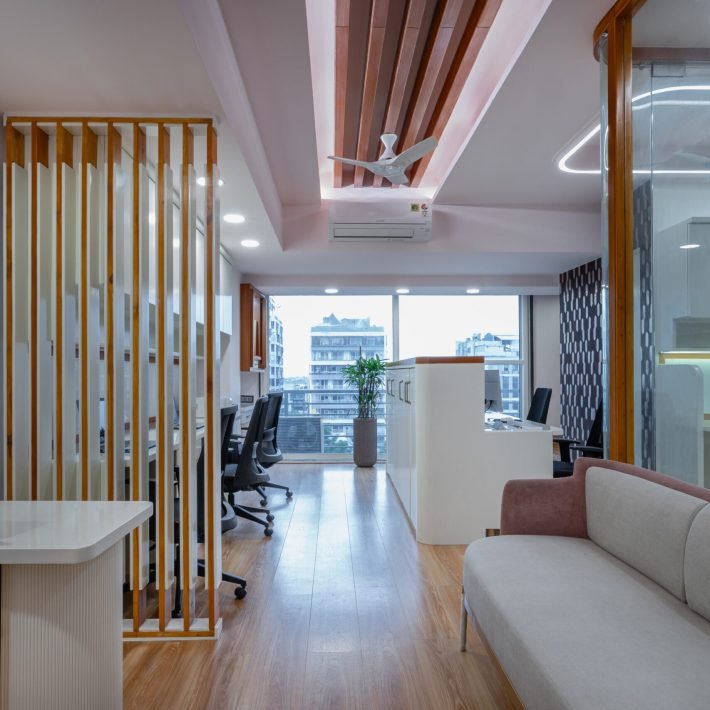
The clinic belongs to a gynecologist and a spine specialist, and this comes through the very second you step through the elevator into the clinic. Two curved walls encase the reception area, one representing the curve of the spine and the other of the womb. The space then fans out into a horizontal waiting room with light spilling in through the wide windows, where visitors can comfortably idle away their waiting time. A small AV nook with a LCD unit and sound system serves as a visual medium to expound medical procedures and processes to the visitors.

“To retain the open spatial feel, give both doctors their personal space, and separate the patients as they move in, the cabins have been relegated to two corners on opposite ends of the waiting room. Connective corridors link the waiting rooms to the other OPD cabins like the pediatric and sonography units”, informs Pragya Sanghavi, Director,
Pentaspace Design Studio.

Sweeping right through the clinic and into the private cabins is the calming pastel tonality that adds subtle colour and warmth to the space. Eschewing loud or overpowering hues, the colour palette of peach, white and light green aligns with the peaceful feeling that emanates within the space, balancing out the bouts of anxiety and nervousness that visitors may be dealing with. “A space as sensitive and high traffic as a medical clinic comes with an array of requirements, challenges, and even opportunities. Aspects like flow of light, availability of adequate storage and use of low maintenance materials dictated many of the design details, including use of paint and laminate that can be wiped down, stain resistant flooring, and refurbished wooden doors with hazed glass panels to let sunlight filter into the rooms”, concludes Bhakti. 

All in all, the thoughtful, coherent, and carefully considered design ensures that the space neither looks like a clinic, nor feels like one.

Photography: Sagar Karnik Photography
Related articles

Designed by SAI Consultants, Sandipani School is shaped around an old Banyan tree, turning an existing natural element into the architectural and experiential heart of the campus. The Sandipani Vidyalaya Programme is a flagship initiative of the Government of Madhya Pradesh aimed at strengthening academic practices and school-level governance. Sandipani School, Shahpur, Burhanpur, is one of the 276 schools across Madhya Pradesh developed by SAI Consultants. “During our first site visit, we discovered the most precious design element already present on the site—a 70–80-year-old Banyan tree. We immediately knew that the entire concept and planning had to revolve around this Vat Vriksha. Rather than treating it as a landscape element, we envisioned it as the first classroom, the heart, and the soul of the campus.” Explains Ar. Mayooree Saxena, Founder and Principal Architect, SAI Consultants. The Kindergarten block is therefore not simply built around the tree, but designed for the tree. The Banyan becomes the central courtyard, assembly space, storytelling circle, and a living memory for generations of students. Kindergarten classrooms open directly onto the shaded courtyard, finished with a soft, non-slip rubber deck. A 6-metre radius around the trunk is maintained as a no-construction zone, protecting the tree and its natural drip line. Sand pits and outdoor chalkboards are integrated beneath its shade, transforming the courtyard into an informal learning environment. The campus is organized through a clear academic hierarchy. The front zone accommodates Kindergarten, administration, and parent waiting areas. Primary and Middle School occupy the lower floors, organized around internal courtyards, while the upper floors accommodate Secondary and Senior Secondary classrooms, laboratories, and the library. A dedicated service zone houses the midday meal kitchen, dining hall, staff facilities, and bus bay, ensuring service movement remains separate from academic circulation. A continuous shaded verandah forms a loop connecting the campus, allowing students to move comfortably while remaining protected from Burhanpur’s intense sun Learning & Community Spaces like Modern Biology, Physics, and Chemistry laboratories feature generous daylight, ventilation, preparation rooms, and island counters for collaborative experiments. The library is positioned opposite the Banyan, creating a symbolic balance—one tree provides shade, the other provides knowledge. Dedicated spaces for dance, music, and art encourage creative learning, while a 300-capacity dining hall, student-maintained kitchen garden, and colorful handwash courtyards integrate community, nutrition, and everyday learning. The multipurpose hall at the entrance accommodates large gatherings and two badminton courts, supported by an 8-metre-high column-free volume and acoustic treatments. Climate-Responsive Design-Responding to Burhanpur’s extreme summer temperatures of up to 45°C, the campus uses North–South orientation, 2.4-metre-deep verandahs, reflective terrace finishes, Kota stone flooring, and courtyard-based ventilation. Rainwater harvesting systems recharge groundwater around the Banyan, while its canopy creates a cooler microclimate within the Kindergarten zone. Sandipani School is not a school with a tree. It is a tree with a school growing around it. Children enter beneath its shade and graduate having grown like it—deeply rooted in values and reaching outward in knowledge.